وطن برس
W
By Engineer Ali Jabbar
In politics, attacking an opponent does not necessarily weaken them, and escalating a political confrontation does not always produce the intended result. Sometimes, an attack becomes an unexpected opportunity for its target, giving them greater visibility, attracting public attention, and bringing together supporters who may not necessarily agree with their political positions but reject the way they are being treated.
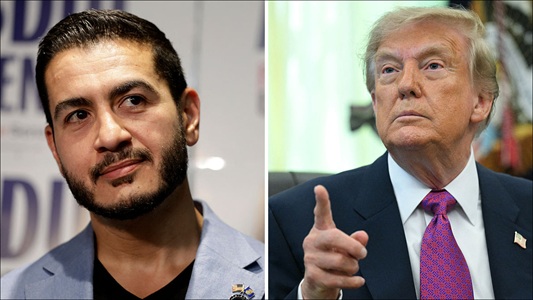
This political paradox deserves closer examination through President Donald Trump’s confrontation with Democratic candidate Abdul El-Sayed in Michigan.
From 2018 to 2026: A Different Political Trajectory
Abdul El-Sayed is not a newcomer to American politics. In 2018, he ran in the Democratic primary for Governor of Michigan, securing 342,179 votes, or 30.2% of the vote, against Gretchen Whitmer, who won the nomination with 52%.
Eight years later, his return to the political arena unfolded under very different circumstances. He moved from being a candidate with a largely statewide political profile to becoming a figure in the national political and media debate.
On November 3, 2026, he won a seat in the U.S. Senate representing Michigan, receiving 2,507,454 votes, or 52.5%, compared with 2,172,586 votes, or 45.5%, for his Republican opponent, Mike Rogers.
Sources: Ballotpedia, Michigan 2018 and 2026 election results.
The question, therefore, is not simply how El-Sayed won, but what helped expand his political profile during this period. Did Trump’s escalating attacks become part of that equation?
Trump: When Media Influence Becomes a Double-Edged Sword
Trump has an extraordinary ability to turn almost any issue or individual he engages with into a subject of widespread public attention. However, that ability does not always guarantee that the resulting attention will work in his favor.
As his attacks on El-Sayed intensified, including questioning his loyalty and associating him with extremism and terrorism, media coverage of the candidate expanded. The contest was no longer limited to El-Sayed’s campaign platform or political positions.
For segments of the public, the issue evolved into a broader debate about the boundaries of political discourse and the right of candidates to participate in public life without being targeted on the basis of their religious identity or background.
This is where a political paradox emerges: an attack intended to diminish an opponent can end up giving that opponent a much larger platform to introduce themselves, defend their positions, and reach new audiences.
The Numbers Reveal a Deeper Political Mood
A Marist Poll conducted in Michigan between September 24 and 27, 2026, surveying 1,235 registered voters with a margin of error of ±3.8 percentage points, revealed several noteworthy indicators:
- 42% said their vote in the congressional elections was primarily an expression of opposition to Trump.
- 20% said their vote was primarily an expression of support for Trump.
- 57% disapproved of Trump’s job performance, compared with 41% who approved.
- Among independent voters, El-Sayed led Mike Rogers by 48% to 45%.
Source: Marist Poll, Midterm Elections in Michigan, September 2026.
These figures do not establish that Trump’s attacks directly caused El-Sayed’s victory. They do, however, demonstrate that voters’ attitudes toward Trump were a significant factor in Michigan’s political environment, and that the election was shaped by more than traditional party loyalty.
The Most Significant Indicator: When Voters Change Sides
In Dearborn, a city with a substantial Arab American population, The Washington Post reported on October 27, 2026, on voters who had supported Trump in the 2024 election but subsequently expressed support for Abdul El-Sayed in the 2026 Senate race.
Their shift did not necessarily reflect a complete embrace of the Democratic platform. Rather, it was linked to concerns about foreign policy, war, the economy, campaign promises, and the way El-Sayed was being treated.
This highlights an important aspect of voter behavior: people do not always vote for the candidate with whom they agree on every issue. Sometimes, they support a candidate because they see that person as a means of expressing opposition to another political figure or administration.
In electoral analysis, this is often described as protest voting or punitive voting—when dissatisfaction with one political actor becomes a primary motivation for supporting an alternative.
Source: The Washington Post, report on Arab American voters who supported Trump in 2024 and their views of Trump and Abdul El-Sayed, October 27, 2026.
What Does This Mean for Iraqi Politics?
In Iraq, political disputes frequently turn into campaigns of personal attacks, accusations, character assassination, and attempts to discredit opponents. Some political leaders appear to believe that damaging an opponent’s public image is enough to push them out of the political arena.
Yet political experience shows that excessive reliance on this approach can produce precisely the opposite result.
When political criticism crosses the line into personal targeting, three things can happen:
- The targeted individual gains greater media exposure and public recognition.
- Different groups begin to rally around that individual, not necessarily because they support their ideas, but because they reject the manner in which they are being targeted.
- Public attention shifts away from the individual under attack and toward the motives and conduct of those leading the campaign against them.
Genuine political competition is not won through defamation or repetitive accusations. It is built on credible programs, measurable results, and the ability to persuade the public.
Conclusion
Trump was not the only factor behind Abdul El-Sayed’s political rise, nor can the attacks against him be considered the sole explanation for his electoral victory. Economic, partisan, electoral, and broader political factors all played a role.
Nevertheless, this experience illustrates an important strategic lesson: media influence does not always translate into control over the outcome of a political contest. Excessive attacks on an opponent can give them the visibility, recognition, and broader public support they might otherwise have struggled to achieve.
In politics, not every opponent needs to be given a fight, and not every confrontation is worth pursuing.
Sometimes, your opponent does not need to build their own public profile. You do it for them.